
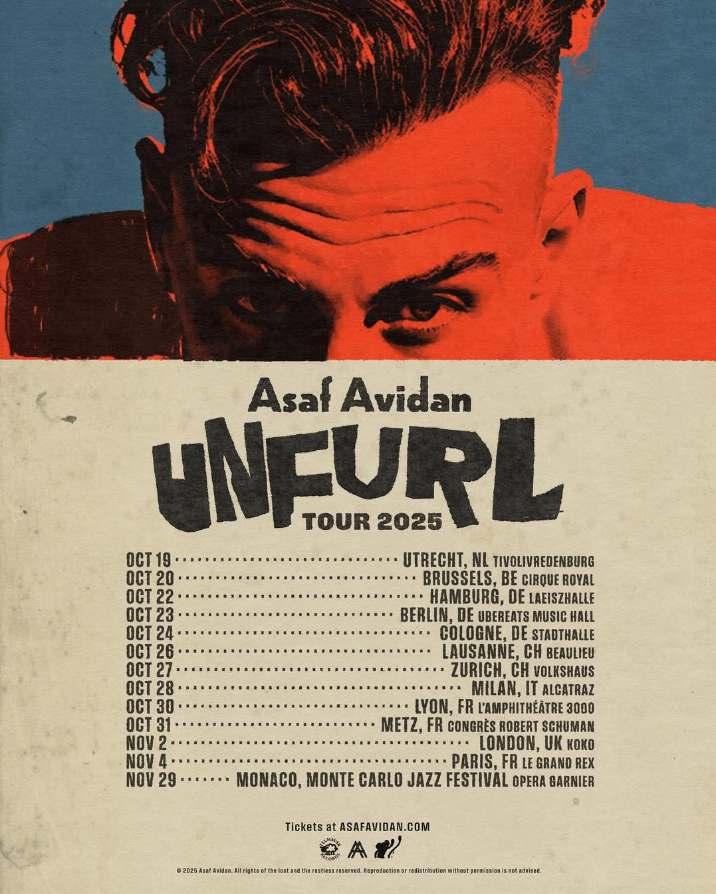
With a voice that defies convention and a sound that blurs the lines between folk, rock, and soul, Asaf Avidan has carved out a singular place in the global music landscape. Rising to prominence with the hauntingly raw Reckoning Song, later remixed into the international hit “Reckoning Song (One Day)” Avidan has since become a genre-bending storyteller whose work is as emotionally unfiltered as it is musically adventurous. Whether performing solo with a guitar or leading a full band, his performances carry an intensity that speaks directly to the human condition.
In the interview, he opened up about the melancholy that seems to linger over humanity. He also gave us a glimpse into how he’s been feeling about the ongoing situation in Ukraine.
Asaf, how does it feel to finally be back on tour after such a long time?
Asaf: Honestly, it feels incredible. It’s exciting, captivating, and challenging all at once. I’ve been really busy analyzing myself through my music, and I feel like there was a part of me that had been quiet, inactive, almost hibernating. That part has now awakened — hungry and full of energy. The challenge for me now is to channel that energy and hunger without going overboard because whatever I learned during this quiet, strangely peaceful time of flexibility, I want to bring that to the stage. So it’s a bit of a balancing act between this wild energy and the calmness and maturity I’ve gained over the past three years.
What connects you to Italy, and why did you choose an old farmhouse as the setting for writing your album Anagnorisis?
Asaf: Actually, I didn’t have any real connection to Italy before. You know, Israel is a very small, rather dry country, so the landscape never gets very green. Every Israeli secretly dreams of a Tuscan farmhouse — with green hills, poppies, and trees — basically the opposite of what we usually see in Israel. That dream had been in my mind and heart for a long time. Then I met some people who invited me to a region I didn’t know before, Le Marche, and I fell in love immediately. Israel is a country built on a myth and ideology born from the victim narrative — after WWII and the Holocaust, our motto has been “never again.” We became a country of institutionalized fear, an eternal fear. I don’t like it, but I understand it. I get why for my grandparents, my parents, and for us, it’s a lasting trauma and why we live in fear. But that’s not how I want to live. When I saw how other people live with a love for their country that isn’t fanatical or fearful, but respectful, I wanted to shape my lifestyle in a similar way. So my company bought this old farmhouse, we turned it into a music studio — both a recording studio and a place to write music — and that dream came true for me. I recorded my current album there, composed a French soundtrack for Mélanie Laurent’s film The Dancer, and rehearsed for my tour there as well.
So will you be traveling to Italy more often in the future?
Asaf: I’m not sure if it’ll always be Italy because I’m a bit of a gypsy and might find another place that feels right. But I know it has to be a place like Italy — peaceful, green, quiet, away from crowds, close to trees and animals. That’s something I’ll always strive for.
Your song “Lost Horse” deals with a feeling often mistaken for love. What kind of people are you usually drawn to?
Asaf: The worst kind. (laughs) No, seriously, there’s a part of me drawn to a certain kind of brokenness because I feel like maybe I can heal it. Maybe I’m hoping to be saved through that. But honestly, as I get older and have more experience with pain and brokenness, I just want people who have their shit together. People who have a solid footing in life and don’t need me to stand on both feet themselves. That’s an interesting question because this has been changing for me. I’ve been in a very stable relationship with a young Italian woman for four years now. It’s completely different from my past relationships. I’m trying to be a healthier person. Early on, in my first interviews or articles, it was different. I remember a reporter once ended an article about me with: “Let’s hope this sad heart never heals so he can keep writing these songs for us.” And I thought, oh god, I hope she’s wrong. Because I want to believe I can still write meaningful songs even when I’m healthier. That’s something I’m trying to achieve in my life. I believe love — and the turmoil of love — plays a big role in our lives. One might ask: why do we need a relationship at all? Why not just love yourself and be happy? Then you inevitably ask yourself: why is nothing ever enough? Deep down, I think everyone carries a certain melancholy. Because even in the best case, even if you’ve had the most amazing life and never went through any hardship, one day you’ll die. Your children will die. Their children will die. The planet will eventually cease to exist. The sun will die. The universe will expand into cold nothingness. We all know this, yet we dare to believe we’re immortal and important — and that love is the answer to everything. I think that melancholy is always there — whether you live on the street without friends or you’re the richest person in the world. It doesn’t matter. There’s a basic, universal human need tied to loneliness and melancholy — and that’s something I like to explore, or rather, something I have to explore. Because even though I’m in a steady relationship, I still write songs about loss, fear, and hope.
Do you emotionally put yourself back into the past, or how do you connect with that emotional state when you perform?
Asaf: A song like Lost Horse draws a lot from the past. Usually, I start with something very specific — a certain girl, a particular moment, a specific relationship. But when I’m writing, my job is to not get too concrete. I try to keep the songwriting a bit more abstract for two reasons. One is that I hope to still be singing these songs in 50 years. So the songs need to remain relevant beyond the moment I sing them today. For example, when I play Reckoning Song, which I wrote back in 2008, I’m not singing it for the girl I originally wrote it about. It’s ambivalent enough that my present self can place itself into the sadness I felt in 2008. The second reason is even more important: everyone should be able to relate to the song. If it’s too specific, it’s just a story you listen to. But if it’s an abstract expression of loss, broken hope, and the will to keep going, then you can bring your own experiences — your own dreams, fears, and love — into your interpretation. So my songs start at a very particular point but eventually grow into something bigger than that original moment.
When you’re on stage, do you still think about that one person you wrote the song for, or are you fully in the present?
Asaf: No, it has to be real. Every time I go on stage — I’m vegan, so I don’t like this metaphor, but it fits — I’m like a fisherman. I cast my line into the lake and catch a certain feeling. I can’t fish for the same fish for fourteen years — that would be pointless. I don’t want to lie on stage. I don’t want to pretend I still have feelings for a girl who means almost nothing to me now. I have to find someone or something I genuinely feel for in that moment, and bring that feeling into the song. So if you ask me if I think about that specific girl — the answer is no. But if I think about how broken I felt back then and translate that into something from today — then yes. Because the truth is, every night on stage, I go through a lot of pain.
If you had to choose, who would you rather go on tour with: Bob Dylan or Radiohead?
Asaf: Oh my God, that’s an amazing question. I’d like to say Bob Dylan because he means more to me. He and Leonard Cohen were the biggest inspirations that made me want to become a musician and why I still make music today. But Radiohead feel more relevant to me now, and they mean a lot to me as well. Plus, they’d probably be way more fun on tour than a quirky 80-year-old. Still, I’d say Dylan, simply because he won’t be around forever. So if I had the chance, I’d take it.
What’s the first thing you notice when you look in the mirror?
Asaf: Oh my God! Jesus… I don’t think it’s one particular thing. I think it’s more general self-hate. Usually, I really don’t like how I look, and I have to deal with that.
Why is that?
Asaf: I just don’t feel as good-looking as I’d like to be. Not as young as I’d like to be. Not quite the way I want to be, generally. But if I had to pick one thing, maybe my hair, because it somehow stands for both a choice and aging. So probably my hair.
Who is your biggest fan?
Asaf: I have no idea. You’d have to ask the fans. There are people I know are big fans of mine, like my mom — she’s definitely a huge fan. But I’m not a fan of the word fan. Because it creates a feeling I don’t want to inspire in people who like my music. I don’t want fans in the traditional sense, because I don’t want blind loyalty. Instead, I see it as my job to constantly renew my connection with them. I want to keep working to make sure people come to my shows. I don’t like the word “fans” because it implies some imaginary person who follows me no matter what I do, and that’s not what I’m aiming for.
What do you want to achieve in the next 900 days?
Asaf: I want to find a balance between everything we talked about earlier — a healthy balance to keep both of my very different personalities alive.
You had planned shows in Moscow, Kyiv, and Odessa. What do you think about the current situation?
Asaf: Of course, my thoughts on the current situation are that it’s a catastrophe — not just for Ukraine and its people, but for the idea that the world is moving forward. That decisions like this still happen instead of diplomatic and economic solutions that could work for both sides. It’s really hard to understand. As you said, a few weeks ago we didn’t even doubt we’d play shows in Moscow and Kyiv. But now we see how fast things can change. People are buying bomb shelters — and that’s not the same as a pandemic, which is hard to prevent. This war could definitely have been avoided. Right now, I mostly feel helpless, and it makes me realize how fragile our privilege is. On the other hand, I try to find a tiny — you know, I’m always looking for a silver lining, for hope. NATO might become stronger because of this. Maybe it’s a consequence after years of “America First,” “Italy First,” “Germany First.” Now more and more people realize we need global solidarity. There’s a growing understanding that our generation doesn’t really know what a true global conflict is — and now we’re at the start of one. Maybe we’ll be more vigilant about protecting what we have: peace, diplomacy, freedoms of all kinds, democracies. Both the pandemic and the current situation in Ukraine should be warnings to stay alert, because we could lose a lot if we don’t wake up soon.
And finally, do you have a message for your fans in Germany?
Asaf: I’ll tell them what I tell my audience every night on stage. Anyone who comes to a concert gets the full version of it. I want people to not be afraid to feel the full complexity of being human. Lately, I hear too often that music is an escape — and I think that’s completely wrong. Music is the opposite of escapism. It’s about laying dignity and beauty over our own soul — or rather, the most miserable, dirty, darkest parts of our soul. By giving those parts dignity and beauty, we can live with them and not be controlled by them. Don’t be afraid of your feelings — that’s my motto. Though, as usual, it’s easier said than done.
Asaf, thank you so much for the honest and inspiring conversation!
Note: This interview was conducted prior to the recent escalation in the Middle East.

 Underdog Magazine